Wind-Down Routines
A Traveler's Guide to Bedtime Routines in Hotels
By Nora Vale · June 18, 2025 · 7 min read
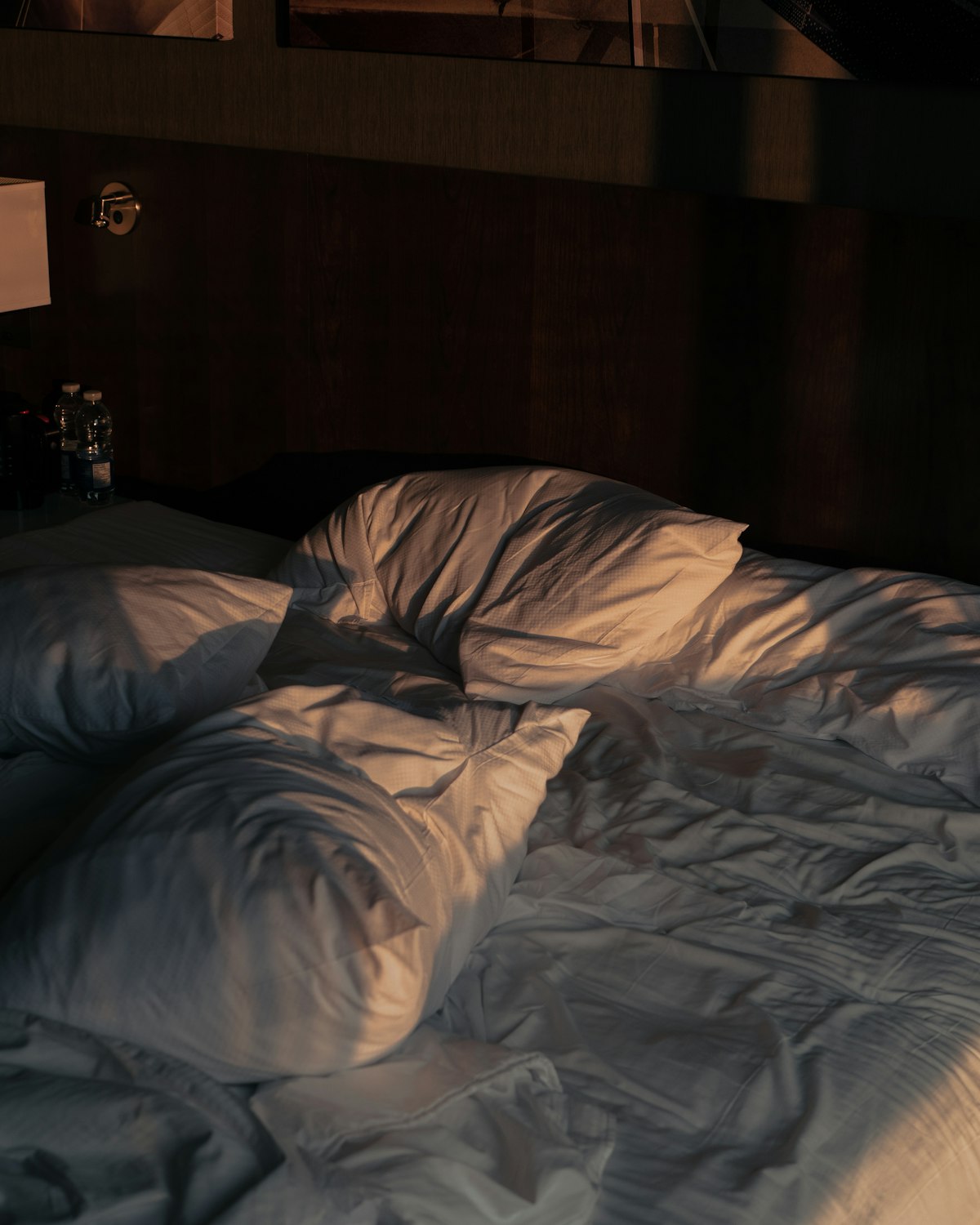
Ten forty in a hotel in Chicago, and the room was fighting me on three fronts: a thermostat that ignored me, a curtain gap wide enough to read by, and the blinking standby eye of a television I never turned on. I knew every one of these problems. I had fixed all of them at home, years earlier, and I lay there in a $200 room doing ceiling math like a beginner. The routine hadn’t failed. I had traveled without it.
That night taught me the thing this post is about: a travel bedtime routine works because the sequence travels, not the bedroom. Your brain doesn’t condition on square footage. It conditions on the same dim, dull, repeated steps arriving in the same order until they read like a sentence it knows by heart, and none of that requires your own nightstand. The full method lives in the wind-down routine guide. This post is what it looks like folded into a duffel bag.
Key takeaways
- The routine is a sequence, and sequences travel: dim, wash up, something quiet, bed, in that order, anywhere.
- A twelve-dollar kit fixes most of what hotel rooms do wrong: LEDs, curtain gaps, noise, cold floors.
- Local time starts at landing, not at the second morning, and day-one naps stay capped and early.
- The five-minute version is the one you will actually run on the road, and it counts as attendance.
- Practice the travel version at home first, because a tool you have never used will not save you at midnight in a strange city.
Why the room is not the routine
The active ingredient in any wind-down is conditioning, and conditioning doesn’t care about your intentions, only your repetitions. Warm water means clean teeth. Clean teeth mean the lamp goes off soon. Each step tugs the next one into place, and that chain can be built anywhere a lamp and a faucet exist. The hotel room is a stranger, but the sequence isn’t, and that is the whole trick.
It helps to know what you are not doing, too. You are not casting a spell over a strange room. You are building a reflex, and reflexes follow the same three moves in the same order whether the walls are yours or not. The book’s version of this is one line: “The sequence doesn’t need your own bedroom to work. It just needs to happen.”
That reframe matters because travelers tend to surrender at the door, on the theory that sleep in a hotel is a lost cause before it starts. It isn’t. The room has four dials, and three of them fit in a pouch.
The kit: what travels and what doesn’t
Tom drives long-haul and sleeps in a different hotel three or four nights a week, and his kit is the best argument for the whole idea. It costs about twelve dollars and it lets him turn any roadside room into a place that obeys the same four rules as his own bedroom back home: foam earplugs, a full box with a spare pair stashed in the truck; a small roll of electrical tape for LED lights and curtain gaps; two binder clips and a dark T-shirt to pin a thin curtain shut against the frame; and a pair of bed socks for rooms the heater forgot.
Ten minutes of setup, any room. Tape the LED, clip the curtain shut, plugs in, socks on, and a thermostat that ignores him gets answered with an extra blanket instead. He told me the kit turned hotels from something he endured into something he sleeps in, and the reason isn’t mystical. A room doesn’t have to be yours to work. It just has to stop arguing.
Noise works the same way as the light does: your brain doesn’t care much about steady sound, it cares about change, so the earplugs plus the bathroom vent or the fan handle the hallway and the ice machine better than wishing would. If you want the fuller version of the dark-and-quiet playbook, it lives in the post on the blackout bedroom for day sleep, which is the same physics with higher stakes.
The sequence, hotel edition
The template survives the trip with its shape intact: dim whatever dimmable exists, wash up, something quiet, bed. The hotel version usually shrinks, and shrinking is fine, because the routine doesn’t need your perfection, it needs your attendance. A workable thirty-minute travel edition looks like this.
- Dim the room. Kill the big overheads, leave one lamp, tape the television’s standby eye. The curtain gap gets the T-shirt and the binder clips now, not at midnight.
- Wash up warm. A shower an hour or two before bed helps the temperature drop that invites sleep, and hotel water pressure is nobody’s enemy here.
- Something quiet that isn’t a feed. Twenty pages of a paper book, a crossword, the sketchpad. Anything that isn’t a screen, because the feed is a live wire dressed up as a wind-down.
- Stage tomorrow. Clothes over the chair, bag by the door, the first three tasks of the morning on hotel stationery. Every loop you close at nine-thirty is a loop your sleeping brain doesn’t have to hold open.
- Dock the phone across the room. The charger goes by the door or the desk, not the nightstand, and a ten-dollar alarm clock handles the wake-up if you carry one.
That last item outweighs the rest combined, on the road more than at home, because the phone is a clock, a feed, and a job in one rectangle, and hotel ceilings give it better acoustics.
Jet lag meets the routine
A strange room is half the travel problem, and the clock is the other half, so the routine runs alongside three daylight rules. Adopt local time from the day you land: meals, light, and activity on the local schedule, even when the appetite and the body both object. Cap any day-one nap at twenty to thirty minutes and finish it by mid-afternoon, because a long, late nap quietly re-locks the clock onto home time. And get outside in the local morning, because daylight arriving at the right hours is the strongest reset the clock accepts.
The napped-too-long version of day one is the classic traveler’s mistake: land at noon, sleep until dinner, lie awake until four. The routine can’t out-argue that. The nap cap can, and the guide to morning light and sleep covers the daylight half in full if your trips run long.
The five-minute version, and the honest limit
Travel nights are exactly the nights everything falls apart, and the fix is the same one that works at home: a five-minute version with everything optional except the shape. Lights down low, ten slow breaths while the toothbrush does its work, phone across the room. It won’t feel like enough, and most nights it is, because what you are protecting isn’t the activities, it’s the sequence.
The honest limit: the first night will feel faintly ridiculous, running a bedtime routine designed for a four-year-old in a room with somebody else’s art on the walls. Do it anyway, because the silliness is load-bearing and the version you actually repeat wins. The routine you build at home is the one that shows up in Chicago, and a tool you have never used will not save you at midnight anywhere.
Frequently asked questions
Do bedtime routines work in hotel rooms?
Yes, because the active ingredient is the repeated sequence rather than the room. The same dim, dull, ordered steps condition your body anywhere, and the book’s line for it is direct: the sequence doesn’t need your own bedroom to work, it just needs to happen.
What should a travel wind-down kit contain?
Foam earplugs, a roll of electrical tape for LEDs and curtain gaps, two binder clips and a dark T-shirt to pin a thin curtain shut, and bed socks for cold rooms. It costs about twelve dollars, takes ten minutes to deploy, and turns a hostile room into a neutral one.
How do I handle jet lag with a hotel routine?
The routine handles the room, and three daylight rules handle the clock: local time from landing, capped early naps on day one, and outdoor light in the local morning. The clock takes its setting from when light reaches your eyes, so feed it the local hours.
What if the hotel room is too bright or loud to sleep in?
Fix the light with tape and clipped curtains, fix the noise with earplugs plus a steady masking sound from the vent or fan. The brain cares about change more than volume, so a steady floor of sound hides the ice machine better than quiet does.
How long before the travel version feels normal?
The first night it feels silly, and that is expected rather than a problem. The travel routine works because you rehearsed the same short sequence at home, so the reflex already exists when the strange room arrives. Attendance builds it, not intensity.
The best hotel sleep I’ve had started with a T-shirt clipped over a curtain gap and a phone charging by the door. Twelve dollars of equipment, three moves in the same order, and a room that finally stopped arguing.
This guide is educational, not medical advice. If sleep problems persist for months or arrive with symptoms you can’t explain, a doctor is the right door.