Bedroom & Sleep Environment
How Dark Should a Bedroom Be for Sleep
By Nora Vale · June 15, 2025 · 7 min read

For two years my bedroom looked perfectly normal in daylight, and it took me a year of lying awake to connect the seven tiny glowing points in it to the fact that my brain never quite slid under. If you’ve wondered how dark should a bedroom be for sleep, the honest answer is darker than yours almost certainly is right now, and the good news is that the gap costs about two dollars to close. The full room system is in the bedroom sleep environment guide.
Key takeaways
- The standard is cave-dark: after five minutes of adaptation, a raised hand should be barely visible.
- Your retinas report light all night, so every visible glow is a running claim that the day hasn’t ended.
- Pinprick LEDs and window glow are the two usual suspects, and both are cheap to fix.
- Nightlights belong outside the bedroom’s sightline if they’re needed at all.
- Darkness sets the floor. A perfect dark room can still lose to a 4 p.m. coffee.
The standard: cave-dark, not laboratory black
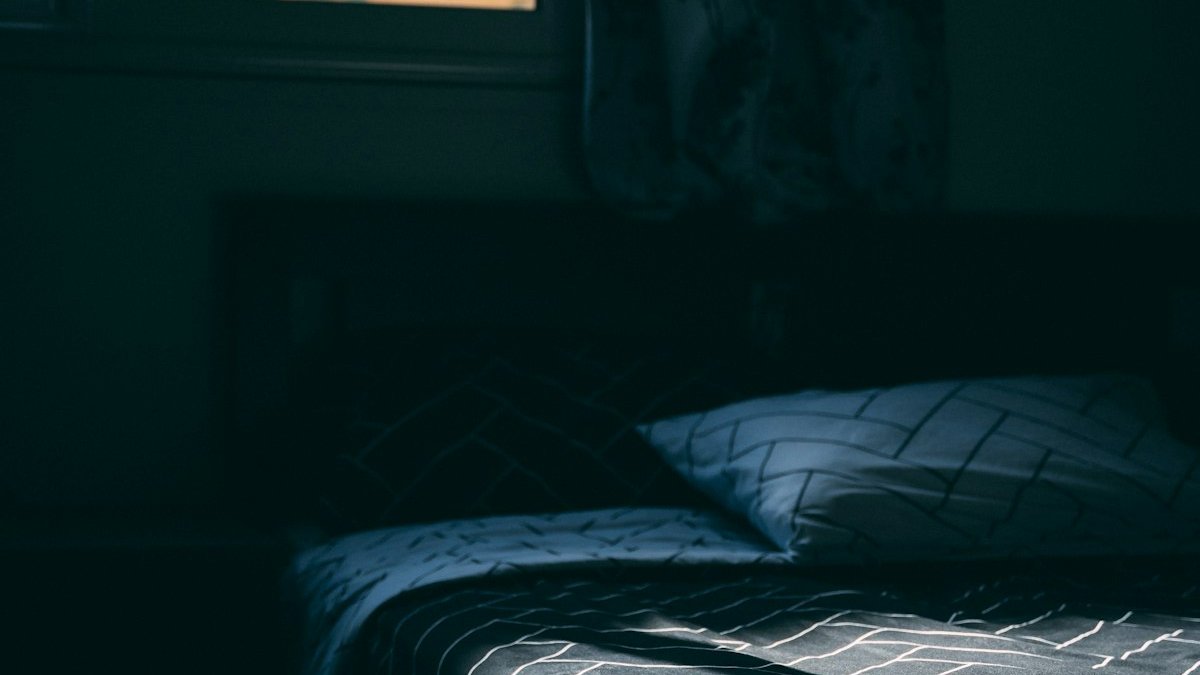
The useful standard isn’t astronomy-grade darkness, and I want to say that up front, because perfectionism kills more sleep projects than laxness does. The standard is that after five minutes of sitting in the dark, you raise your hand in front of your face and see almost nothing. Faint shadow, fine. A clear hand with visible fingers means light is still reaching you, and your retinas are still filing their report.
Why this test and not a meter or a number: your eyes adapt, and adaptation is exactly what fools you. A room that felt cozy-dim at eleven reads as bright once you’ve been in it a while, and the seven tiny LEDs I eventually counted in my own room had become invisible to me precisely because I saw them every night. “None of it looked like a problem. It looked like a normal bedroom, which is exactly why it took me another year of lying awake to connect those pinpricks to the fact that my brain never quite slid under.” The raised hand breaks through adaptation because it gives your eyes something to check against.
The mechanism, briefly, because it explains the stubbornness of the standard: light hitting your retinas suppresses melatonin and signals the brain that day continues, and the retinas do this all night, not just at lights-out. They don’t get bored of reporting. A room that passes the raised-arm test is a room where the report finally stops.
The two suspects: pinpricks and windows
Every room I’ve ever audited, mine included, has the same two culprits in different proportions. First, the electronics: router starbursts, clock faces, television standby eyes, charger cubes. The fix is tape, literally, and the walkthrough is in how to cover LED lights in the bedroom. Ten minutes and two dollars, and the electronics go silent.
Second, the window, which no amount of taping touches. Streetlight glow through thin curtains keeps the room at a level your eyes read as dim daylight, and unlike a pinprick it covers real area. The fix scales with your commitment: blackout liners behind existing curtains, foil pressed to the glass, cardboard cut to size. Mine has been foil for two years and nobody has ever seen it but me, which is the correct audience for bedroom décor. If you share the bed with a partner who hogs covers or light, the honest negotiation matters more than the fixture, but the glass itself is still the biggest single leak in most rooms.
Then re-run the raised-arm test, because the difference after fixing both suspects is the argument for the whole project. Rooms that pass the test feel noticeably different at 2 a.m., and people who make the change usually notice it in the morning, in how they surfaced, before they can articulate why.
Nightlights, clocks, and honest exceptions
Some darkness rules bend. A child who genuinely needs a nightlight, a hallway path for midnight bathroom trips, an elderly parent’s room: these are real needs, and the fix is placement, not prohibition. Keep any necessary light out of the bedroom’s sightline, low near the floor, dim, and warm-colored, because warm dim light at ankle height in the hallway does a fraction of what a cool bright clock face at eye level does.
The alarm clock is the most common objection, and it’s a solvable one. You don’t need to see the time at 2:40, and seeing it actively hurts, because the time check hands you arithmetic you can’t win. Turn the face away, cover it, or rehome the timekeeping entirely. The phone that replaced the clock is a separate theft, and phone as alarm clock problem covers why the workaround fails.
And the honest limit, which I’d rather state plainly than have you discover: darkness is necessary, not sufficient. I have slept, technically, in a cave-dark room with a taped router and foil on the windows while lying wide awake doing ceiling math, because the afternoon coffee, the evening wine, and a mind with seventeen open tabs had votes too. “So the room is necessary, not sufficient. It sets the floor, and the rest of the book builds on that floor.” Get the room dark because it’s the cheapest lever you’ll ever pull, not because it’s the only one.
Frequently asked questions
How dark should a bedroom be for sleep?
Cave-dark: after five minutes of adaptation you shouldn’t be able to see your raised hand in front of your face. Total blackness isn’t required, but every visible light source and glow should go, because your retinas keep reporting light to the brain all night.
Is a nightlight bad for sleep?
If it’s visible from the bed, yes, it’s one more source keeping the brain half-alert. If you genuinely need one for a hallway or a child’s room, keep it out of the bedroom’s sightline, dim, warm-colored, and near the floor.
What about the light from streetlights through curtains?
That’s a blackout problem, not a pinprick problem, and it’s worth solving with blackout liners, foil, or cardboard on the glass. Street glow keeps the room at a level your eyes call daylight-adjacent and your clock calls wrong.
Does darkness really change sleep quality that much?
It changes the ceiling of what’s possible. Light doesn’t always wreck a night outright, it shaves depth and keeps surfacings sticky, and the effect is easy to miss because it never looks dramatic from the inside.
How long does it take to adapt to a truly dark room?
The room changes faster than you do. The first night or two can feel strangely intense, then within a week most people stop noticing the darkness and start noticing the mornings. If a child or partner needs light, solve placement first rather than re-brightening the room.
The chapter behind this post, including the four-dial audit this darkness standard belongs to, lives in Sleep, Finally. Tonight’s version: five minutes in the dark, raise your hand, and see what your room has been telling your brain all along.
This guide is educational, not medical advice. If sleep problems persist despite a dark, cool, quiet room, a doctor is the right next step, no shame in that.