Exercise, Naps & Sleep
10 Evening Stretches to Replace Late Scrolling
By Nora Vale · August 3, 2026 · 7 min read
My old body slot, in the years before anyone taught me the term, was a fourth glass of wine on the couch with my phone. The new one is ten minutes on the bedroom floor under a lamp, in socks, doing movements that would embarrass me if anyone filmed them. One of those evenings ended in sleep. The other ended in 1 a.m. ceiling time. The wine had better marketing, and the stretching has better results, and this post is the whole sequence so you can steal it tonight.
The stretches live inside a bigger frame, the wind-down’s three slots, which the wind-down routine guide explains and the exercise and sleep guide backs with the actual research. Here, the sequence itself.
Key takeaways
- Gentle evening stretching has real evidence behind it: slower sleep onset, better sleep quality, nothing dramatic.
- The last hour before bed, under a lamp, is the slot. Ten minutes fills it.
- The sequence below is deliberately unambitious, because ambition is what kills routines in week one.
- Keep it on the floor, not the bed, so the bed stays a cue for sleeping.
- A boring routine you repeat beats an impressive one you admire.
Why stretching, and why so slow
The honest science first, because this site doesn’t sell poses. In trials with older adults and with people who already had insomnia, regular gentle yoga or stretching shortened the road to sleep and improved the sleep that followed. Sleep researchers describe those effects as modest, which I find refreshing. Modest beats nothing. It also beats my old body slot by any measure I kept.
What the stretching actually does is simpler than the marketing around it: slow, unclenching movement tells your body the day’s work is over, and your body believes demonstrations more than it believes declarations. You can announce at nine that you’re winding down while your shoulders stay at ear height and your jaw keeps its schedule. Ten minutes on the floor is a demonstration, and the demonstration is what the nervous system reads.
The second reason is situational. If your current last-hour habit is a phone, you’re not replacing nothing, you’re replacing something actively harmful, a feed that hands your brain small questions at the hour it least needs them. The bar is on the floor, pun intended, and a boring stretch clears it nightly. If the scrolling is the main thief, why scrolling keeps you awake explains the machinery, and yoga before bed takes the fuller yoga version.
The ten, in order
Do these on a mat or carpet, in the last hour before bed, with one lamp and no screens. Hold each for five or six slow breaths, switch sides where it applies, and treat the whole thing as eight to ten minutes. The breaths matter more than the depth, so if you remember nothing else, breathe slowly and exhale longer than you inhale.
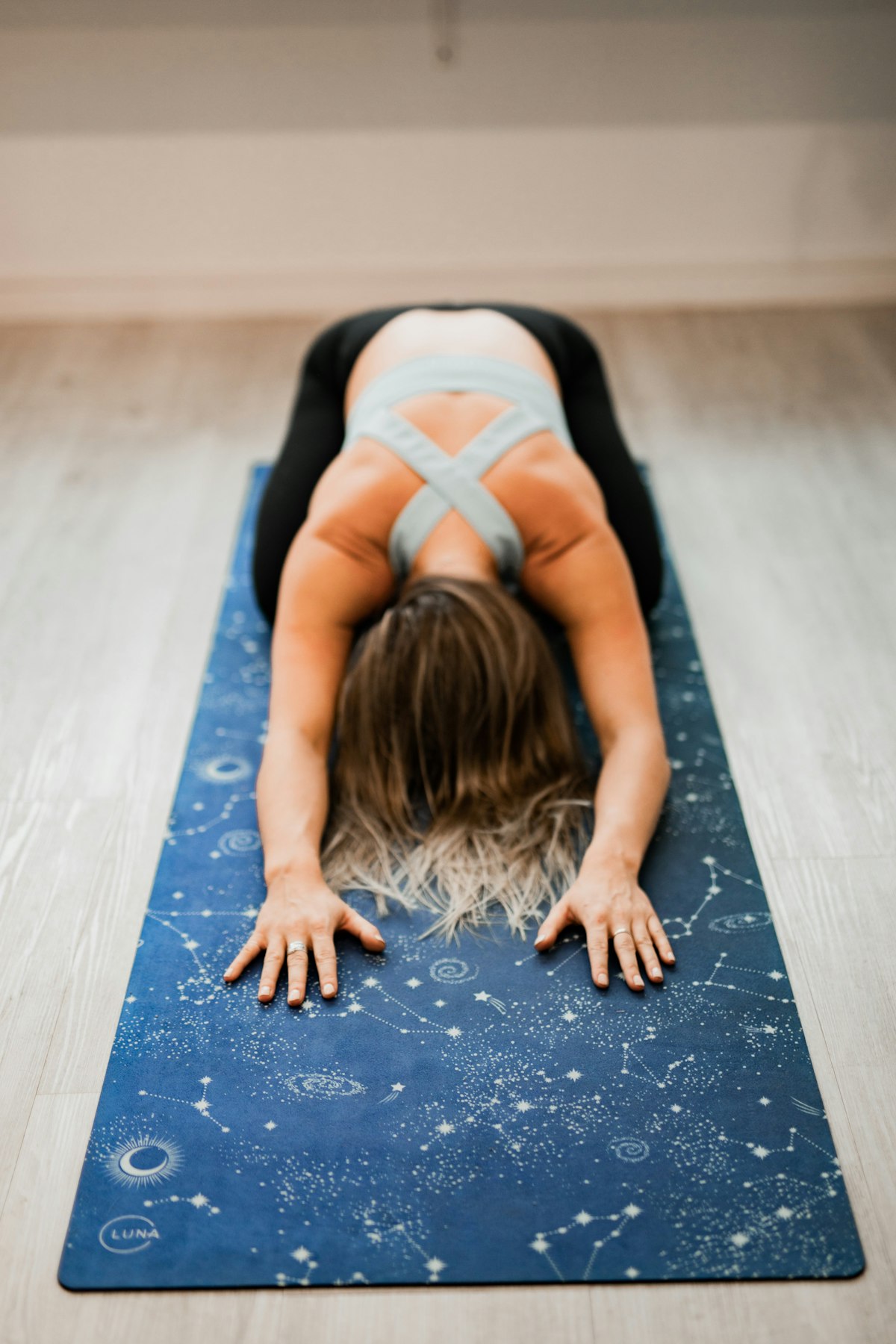
One. Child’s pose. Knees wide, big toes touching, fold forward and rest your arms wherever they land. This is the posture that ends arguments. If your knees complain, a pillow under them ends that too.
Two. Cat and cow. On hands and knees, round and arch the spine with the breath, slowly, like the world’s least athletic feline. Six rounds. The point is motion in a spine that spent the day in a chair, not range records.
Three. Thread the needle. From hands and knees, slide one arm under the body, shoulder to the floor. Hold, switch. This one reaches the space between the shoulder blades where desk days store their paperwork.
Four. Puppy pose. Knees stay, walk the hands forward, chest sinking toward the floor. It’s a stretch and an opening at once, and it undoes the keyboard hunch better than most things costing money.
Five. Seated forward fold. Legs out, fold toward the toes, knees soft and bent as needed. Touching your toes is not the assignment. Lengthening the back of the body with an exhale is.
Six. Figure-four on your back. Lying down, one ankle across the opposite knee, and pull the legs toward you. Hips hold the day’s standing, driving, and sitting, and this is the pose they ask for by name.
Seven. Supine twist. On your back, knees dropped to one side, arms wide, head neutral. Hold, switch. This is where the sequence starts feeling like an ending, which is the idea.
Eight. Legs up the wall. Hips near the wall, legs up, arms out. Two minutes here does more decompression than the other nine combined, and it’s the pose to keep when the evening collapses and you only have time for one.
Nine. Happy baby. On your back, grab the feet, knees toward armpits, rock a little if the mood strikes. It looks ridiculous. It releases the lower back, and the ridiculous is part of the treatment, because dignity is a day-shift concern.
Ten. Slow exhales lying down. Final position, in bed or on the mat: ten breaths, each exhale longer than the inhale. This one is the bridge into sleep, and it’s the only pose with no floor requirement at all.
How to make it stick past week one
The failure mode for evening stretching isn’t injury or boredom with the poses, it’s ambition. My first draft of this routine failed inside a week because I picked the ambitious version: a proper yoga sequence, downloaded, with a teacher’s voice and opinions. What survived was smaller. Two stretches, ten minutes, a lamp. The smaller version is the one still running years later, and that’s the pattern worth copying: the routine you actually repeat wins, and the one you perform twice a week is decoration.
So the sequence above is a menu, not a law. Ten stretches is the full version for a normal evening. Three stretches, child’s pose, figure-four, legs up the wall, is the five-minute version for the nights the evening went sideways, and keeping the shape on bad nights matters more than the content, because the shape is what your body learns to recognize as the beginning of sleep.
Stack it to something that already happens. Teeth are the classic anchor: stretch after brushing, and the sequence inherits the one habit nobody skips. Keep the props within reach, mat already unrolled by the bed, because friction kills evening routines more reliably than laziness does. And give it the two honest weeks any conditioning takes, because the first week nothing seems to happen, and somewhere around day ten you catch yourself yawning during the puppy pose, and the lamp starts feeling like an invitation instead of a deadline. If the whole evening needs building around the stretch, relaxation before bed that isn’t meditation offers more low-key candidates, and can i work out at night draws the line between gentle stretching and the vigorous stuff that genuinely should end earlier.
Frequently asked questions
Do evening stretches really improve sleep?
Modestly and reliably, which is the good kind of claim. Trials in older adults and people with insomnia found gentler, regular stretching shortened sleep onset and improved sleep quality. The mechanism is demonstration: slow unclenching movement shows the body the day is over, and the body trusts demonstrations over declarations.
How long does the whole sequence take?
Eight to ten minutes for the full ten, five minutes for the three-pose minimum of child’s pose, figure-four, and legs up the wall. The short version on a bad night keeps the shape alive, and the shape is what your body actually learns to read as the start of sleep.
Should I stretch on the bed or the floor?
The floor, mostly. The bed is for sleeping, and long stretches of lying awake in it teach your brain that the bed is where thinking happens. A mat by the bed keeps the border, and the final slow exhales are the only part that belongs under the covers.
What if I’m completely inflexible?
You’re the intended reader, and none of the ten requires flexibility. Knees bend, pillows go under things, and every pose has a lazier version that still counts. Doing less, nightly, beats doing more, occasionally, by a distance that isn’t close.
Can I do these stretches right before sleeping?
Within the last hour, yes, that’s the slot. Finish the sequence, turn off the lamp, get into bed. What you want to avoid is treating the stretch as a sleep switch you press while checking whether it worked, because monitoring is effort, and effort is the one guest the last hour doesn’t need.
The sequence is free, the equipment is a floor, and the evidence is modest in the way things that actually work tend to be. Unroll the mat by the bed tonight, do three poses badly, and let week two do the convincing. The book that gave the body slot its name is the Quiet Core Reset.
This guide is educational, not medical advice. If you have an injury or a condition that affects movement, check with a doctor or physical therapist before starting anything new.