Screens & Sleep
Teen Gaming on School Nights: How Late Is Too Late
By Nora Vale · April 3, 2025 · 7 min read
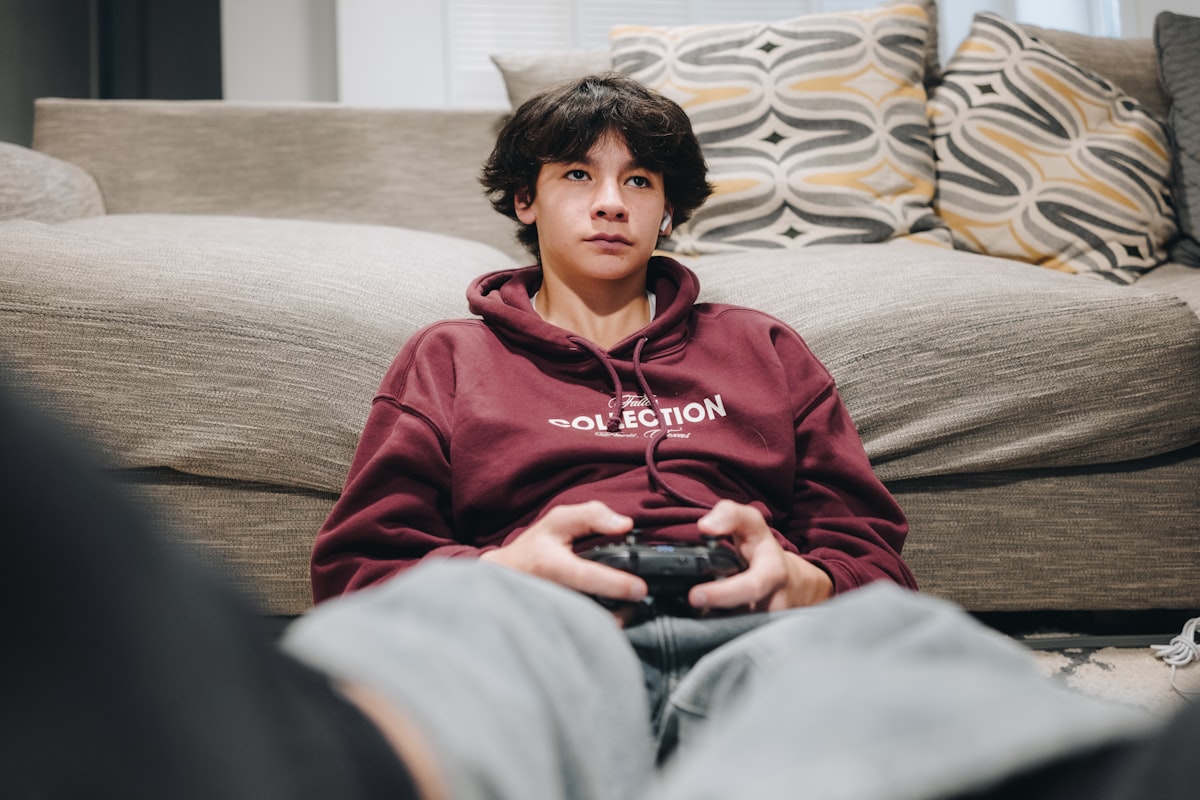
My neighbor’s son ran the same experiment for a month of ninth grade. One quick match at 10:15, headphones on, lights low. Almost every night the quick match ended near eleven, and the lying-awake part ran past midnight, because the game handed his brain a live wire exactly when his body was asking for dusk. He wasn’t rebellious. He was outnumbered, and so is every kid holding a game that was designed by very good engineers to never, ever end.
That’s the honest frame for teen gaming school nights: the question isn’t whether your kid likes games, and it isn’t whether screens are evil. The question is what time the night actually closes, and who controls the last hour. The wider picture, including the phone at bedtime and the feed that eats whole evenings, lives in the guide to screens and sleep, and this post narrows it to one decision most families fight about weekly: how late is too late.
Key takeaways
- Work backward from the wake-up time. A 6:30 alarm means lights out near 10:00, and feed-driven games should end a full hour before that.
- The research says the damage comes mostly from content and lost sleep time, not from the glow of the screen itself.
- Competitive, match-based, and online games are the ones that overrun; slower games with an obvious ending are a different category.
- Rules survive testing when the adults in the house visibly follow the same ones.
- A cutoff decided at 9:00 a.m. holds better than one negotiated at 10:00 p.m., when nobody involved has any judgment left.
Teen gaming school nights: what actually breaks
Start with what the research does and doesn’t say, because the usual story is half right. When researchers pool the media studies that follow children and teenagers, the big ones averaging hundreds of kids at a time, the average effect of screens on sleep comes out small. The damage that does show up traces mostly to two things: content that keeps young minds switched on, and time spent scrolling that should have been time spent asleep. Adults aren’t a different species. “If the content wakes your mind up, it barely matters that the screen is dim, and if the feed eats forty-five minutes, no night-mode setting hands them back.”
A ranked match at 10:30 is both problems at once. The content is deliberately arousing, that’s what competitive design is for, and the session’s end time belongs to the game, not the player, because there’s always one more match, one more rank, one more friend still online. The blue light conversation, which gets most of the airtime, is the smaller half of the ledger. The full accounting of what evening screens actually do is in the post on whether screen time affects sleep.
So the cutoff question is really two questions. When does the body clock need dusk, and which games can share a room with it.
Where the line actually sits
The arithmetic comes first, and it’s the part nobody enjoys. A teenager who needs roughly nine hours and wakes at 6:30 has a lights-out time near 10:00. Melatonin, the darkness signal that eases a person toward sleep, starts rising about two hours before usual bedtime in dim conditions, which means the window from 8:00 to 10:00 is when the night is trying to start. A match-based game at 9:30 isn’t a wind-down with extra steps. It’s a phone call to a different timezone.
Then apply the one-hour rule of thumb that works for adults and teenagers alike: nothing with an infinite scroll or an open-ended match queue in the final hour, even dimmed, even in night mode. That makes 9:00 the practical line for anything ranked, anything online, anything where the game decides when you’re done. Single-player games with chapters, save points, and an obvious ending are different, because they hand the stopping decision back to the player. A game that can end on its own is a different species from one that can’t.
One honest note about the science behind all this: the strictest recommendation in the sleep research world, keeping evening light extremely low for three hours before bed, is stricter than any real household containing children or teenagers will ever achieve. Treat the numbers as a direction, not a test. Moving the cutoff from 10:45 to 9:15 is a real win even if it never looks like the textbook version.
The content matters more than the console
Two practical sorting questions do most of the work here, and they’re the same ones that separate a wind-down habit from a sleep thief.
First: can the game end on its own? A puzzle level ends. A race ends. A ranked ladder never ends, it just offers the next rung. Games in the second category are the ones that quietly turn 9:00 into 10:15, because the stopping decision was designed out of them. That’s not a kid failing at self-control, it’s a product doing exactly what it was built to do, and naming that plainly to your teenager is more persuasive than pretending it’s a character issue.
Second: who else is in the lobby? An online game with friends has no natural exit, because leaving is social, and social exits are the hardest kind. The friends who never log off are the mechanics. This is also why the night before a test plays out differently from a Friday, and pretending otherwise is how rules lose credibility. The cutoff can bend on a Saturday; the school-night version stays a school-night version.
The same content-over-light logic explains why night mode doesn’t rescue a late session.
How to set the cutoff without a war
Teenagers get the real reasons, not a decree from the mountains. That sentence is doing more load-bearing work than it looks, because it’s the difference between a rule that survives being tested and one that doesn’t. Your kid will test it, for sport, and the rule survives testing as long as the adults in the house are visibly following it too. A hallway basket that includes the parents looks like fairness. One that spares only the parents looks like hypocrisy, and teenagers can smell that from another zip code.
Three moves make the line real:
- Decide the time in daylight. The cutoff is chosen at breakfast or on a Sunday afternoon, never negotiated at 10:00 p.m., when the eleven-o’clock version of everybody has no judgment and every incentive to move the line.
- Give the controller a home that isn’t the bedroom. The console, the controller, and the phone all dock somewhere outside the sleeping room. When the equipment lives elsewhere, the 9:00 stop is physical, not a standing argument.
- Fill the gap on purpose. The hour you just reclaimed needs something in it, or the rule reads as punishment. Music, a paper book, a shower, whatever your house already has. The post on what to do in the hour before sleep is a menu, not a mandate.
Expect a rough week, and then the household adjusts, usually faster than the complaining suggests it will.
The honest limits
Some of this is seasonal biology, and saying so makes the rule more credible, not less. Adolescent body clocks genuinely drift later than adult ones, which is a well-documented shift in sleep science, and it’s why a 10:00 lights-out that worked in seventh grade feels harder at sixteen. The cutoff still matters, but the fight over it should be smaller than the fight over whether biology exists.
And no single rule fixes a whole household’s sleep. A perfect 9:00 gaming cutoff can coexist with a bad night if the weekend schedule swings three hours, the afternoon coffee shows up at 6:00, or the feed sneaks in through a different door. If you want the adjacent pieces, the post on why scrolling keeps you awake covers the feed itself, and Netflix before bed covers the auto-play version of the same thief.
If sleep problems run past the ordinary late-night friction, if a school-day exhaustion sticks around for months despite honest bedtimes, that’s a conversation for a doctor, not a stricter rule.
Frequently asked questions
What time should a teenager stop gaming on a school night?
Work backward from the wake-up time. A teen who gets up at 6:30 needs lights out near 10:00 for nine hours, and since nothing with a feed belongs in the last hour, the honest answer for ranked matches and open-world games is 9:00. Slower, single-player games with an obvious ending can stretch into the last hour.
Is one hour of gaming after homework fine?
It depends on the hour and the game, not the total. An hour ending at 8:30 is a very different animal from an hour ending at 10:30, because the last two hours before bed are when the body clock expects dusk. A game with matches that stack, ranked ladders, or online friends who never log off is engineered to overrun that hour.
Does blue light from gaming actually wreck sleep?
Light is the smaller thief. The real damage on school nights is content and time: competitive games keep young minds switched on, and the session eats minutes that belonged to sleep. Dimming the screen or using night mode treats the light half and leaves the bigger problem untouched.
How do I enforce a gaming cutoff without a fight every night?
Explain the actual reasons instead of issuing a decree, and make the rule visible to everyone, adults included. A hallway basket that includes the parents looks like fairness. One that spares only the parents looks like hypocrisy, and teenagers can smell that from another zip code.
My teen sleeps late on weekends. Does the school-night cutoff still matter?
Yes, but be honest about the whole picture. A two-hour weekend sleep-in resets a body clock the way a short flight west does, which makes the 10:00 lights-out on Monday feel like jet lag. The cutoff works best when the weekend wake time stays within about an hour of the school-day one.
The feed will refill itself overnight either way, and it will still be there at 7 a.m. The one thing in this arrangement that closes is the sleep window. Decide the cutoff in daylight, put the controller where it lives, and give the school night its dusk back. If you want the whole system behind that one rule, the full method is in the book, and it costs less than a season of battle passes. Get the Quiet Core Reset book.
This guide is educational, not medical advice. If sleep problems persist for months or arrive with symptoms you can’t explain, a doctor is the right door.